
Equality Must Include Male Vulnerabilities!
New Delhi, India — Men Helpline has expressed disappointment over recent remarks made during discussions at Times Evoke under the theme “Technology and Women’s Rights,” where Artificial Intelligence was portrayed as being inherently “designed by men and for men.”
Men Helpline strongly rejects such characterizations, calling them technically flawed and socially divisive.
Prominent economist and Member of the European Parliament, in the said debate, remarked that the digital world promotes toxic masculinity while overlooking crimes committed by women and male issues. Men Helpline believes such framing risks reducing complex technological governance debates to gender-based narratives.
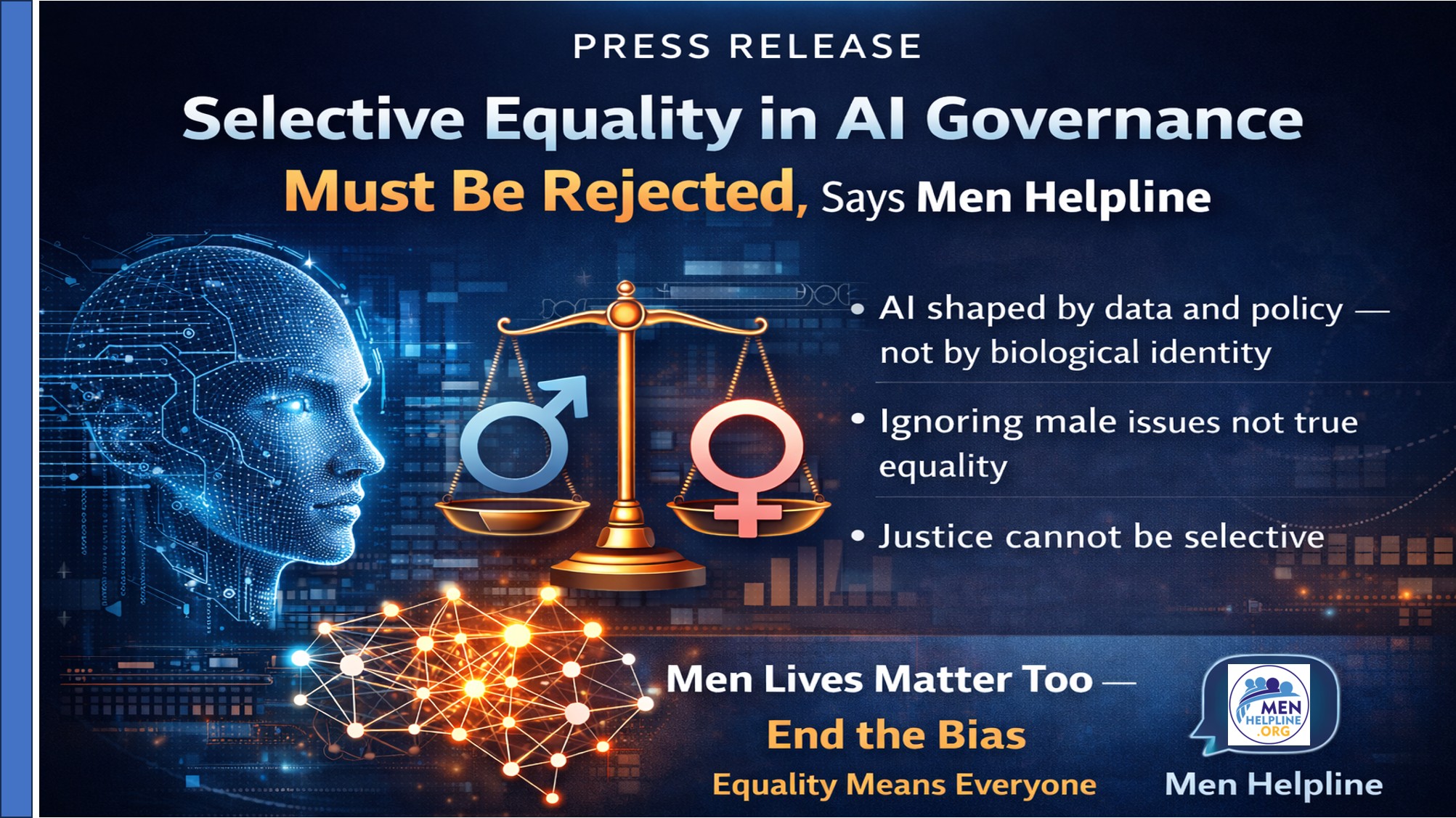
Artificial Intelligence systems are shaped by datasets, institutional policies, and regulatory design — not by biological identity. Reducing complex technological governance questions to gender-origin rhetoric oversimplifies the issue and distracts from measurable fairness standards.
“Selective equality in AI governance risks turning a technical oversight matter into a gender blame narrative,” said Kumar S Ratan, Founder of Men Helpline. “Public policy must remain evidence-based, not ideology-driven.”
Gender is Not an Issue
Men Helpline emphasized that there are ways to identify if any bias exists in AI systems, then the response must focus on structural accountability mechanisms, including:
- Independent audits of training datasets
- Publication of comparative error rates
- Transparency regarding content moderation asymmetries
- Clear disclosure of safety filter design standards
In the debate, while bias was discussed during the debate, no empirical dataset or audit evidence was presented to substantiate claims of systemic gender-origin bias.
We believe that technological governance requires transparency, empirical evaluation, and symmetrical enforcement — not identity-based framing.
Equality Must Include Male Vulnerabilities
While public debates often highlight women’s safety in digital environments, Men Helpline pointed out that such discussions frequently overlook male vulnerabilities, including:
- Male suicide rates
- Male victims of domestic violence
- Boys’ educational decline
- Father–child separation
- Male health concerns such as prostate cancer
- Long working-hour patterns with less compensation recognition
“Equality cannot be partial,” the statement added. “Frameworks that consistently ignore male suffering cannot claim to represent universal justice.”
Overcorrection Is Not Justice
Men Helpline cautioned against bringing new imbalance with AI.
“Protecting one gender by marginalizing another does not build fairness — it institutionalizes asymmetry,” the statement added.
We reject any attempt to redefine equality as a one-directional policy tool.
Men Helpline Propose
Men Helpline advocates for:
- Gender-neutral AI governance frameworks
- Symmetrical safety enforcement mechanisms
- Data-driven and independently verifiable audits
- Transparent regulatory standards
- Universal human protection principles
Men Helpline reiterated its opposition to ideological narratives that divide society into competing victim categories.
Closing Statement
Men Helpline urges policymakers, media platforms, and public leaders to adopt balanced, inclusive approaches when discussing technological governance.
“In a rapidly evolving digital era, all genders are adapting, contributing, and striving for growth in equal environments. Framing AI as a gendered instrument risks deepening division rather than strengthening accountability,” the statement concluded.
AI governance must be accountable to all humans.
Justice cannot be selective.
Men Lives Matter Too – End the Bias
Equality Means Everyone

